
You’re lying on that narrow table, about to slide into the big tube, and suddenly the question hits you: “How much longer until I can get out of here?” It’s one of the most common thoughts people have during a brain MRI, and for good reason.
What Affects the Length of Your Scan?
A typical brain MRI scan takes between 30 to 60 minutes from start to finish. That said, the actual time varies quite a bit based on what your doctor needs to see and the specific type of imaging required.
Several factors determine exactly how long you’ll be in that machine:
Standard brain scans usually clock in around 30-45 minutes. These are your routine diagnostic scans where doctors need basic views of brain structures to check for abnormalities, injuries, or signs of disease.
More detailed imaging can stretch to 60 minutes or longer. If your doctor ordered additional sequences to look at blood vessels, check for tumors, or examine specific regions in greater detail, expect to be there a while.
Contrast dye adds time to the process. When gadolinium contrast is needed (injected through an IV to highlight certain tissues), you’re looking at an extra 15-30 minutes. The technician has to pause the scan, inject the contrast, then resume imaging to capture how it flows through your brain tissue.
Functional MRIs (fMRI) take longer because they measure brain activity while you perform tasks. These specialized scans can run 45-90 minutes depending on the study.
What Actually Happens During Those Minutes?
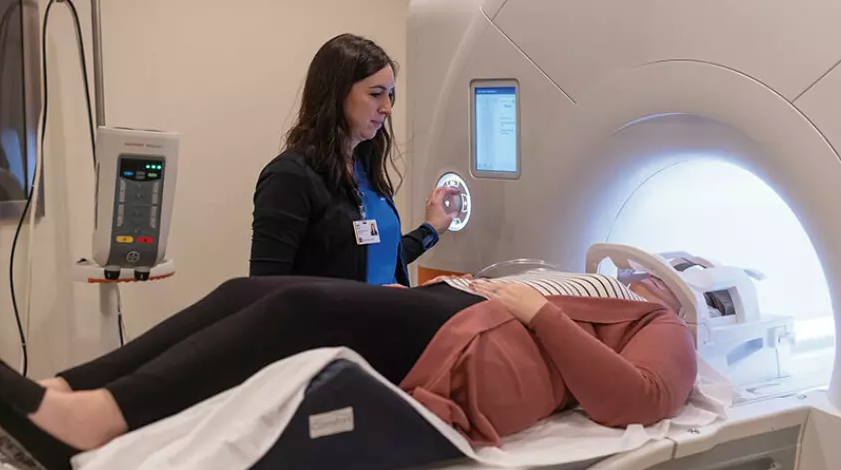
The first 5-10 minutes aren’t even scanning time. You’ll spend this getting positioned correctly on the table, having your head secured in place (usually with a cage-like device or padding), and receiving instructions from the technician. This setup matters because even tiny movements can blur the images.
Once scanning starts, the machine takes multiple series of images, each lasting anywhere from 2 to 15 minutes. Between each series, there’s typically a brief pause. You might hear the technician’s voice checking on you, and the banging and humming sounds change pitch and rhythm as different imaging sequences run.
The machine creates these images by using powerful magnets and radio waves to detect signals from hydrogen atoms in your body’s water molecules. Different brain tissues respond differently, which is what creates the contrast in the final images. Each sequence captures a different aspect of your brain’s structure and composition.
The Sounds and Sensations
That rhythmic knocking, buzzing, and thumping you hear? Those are gradient coils rapidly switching on and off to create the magnetic fields needed for imaging. The louder sequences typically mean more detailed images are being captured.
Most facilities provide earplugs or headphones playing music to dampen the noise. Some people find the sounds relaxing after a few minutes, like white noise. Others find them jarring. There’s no right or wrong reaction.
The confined space bothers some people more than the noise. Modern MRI machines come in different configurations—some are more open than traditional “closed” models, though these may take slightly longer to capture images.
Can Anything Make It Go Faster?
Staying completely still is the single biggest factor in scan efficiency. Any movement means the technician might need to repeat that sequence, adding 5-10 minutes to your total time. Even swallowing, blinking hard, or tensing your jaw can blur images.
Some newer machines with advanced technology can capture images faster, potentially cutting 10-15 minutes off older machines’ scan times. However, this depends on what equipment your imaging center has available.
Arriving prepared makes the process smoother too. Remove all metal beforehand—jewelry, hairpins, underwire bras, watches, anything magnetic. Having to stop mid-scan because something was missed wastes precious minutes.
Special Situations That Take Longer
Brain MRIs for young children often require sedation or anesthesia since staying perfectly still for 30-60 minutes is nearly impossible for most kids. The preparation, sedation, scanning, and recovery can take 2-3 hours total.
Research MRIs or scans looking for very specific conditions might involve multiple contrast injections, specialized sequences, or imaging while performing cognitive tasks. These can easily exceed 90 minutes.
Emergency brain MRIs can sometimes be expedited with “fast brain protocols” that capture essential images in 15-20 minutes when immediate diagnosis is critical, such as with stroke patients. These abbreviated scans sacrifice some detail for speed.
FAQs
Can I move at all during the scan?
Gentle breathing is fine, and blinking normally doesn’t usually cause problems. But turning your head, shifting your body, coughing, or talking will blur the images. If you need to move, tell the technician so they can pause between sequences.
What if I get claustrophobic halfway through?
Tell the technician immediately. They can talk to you through the intercom, pull you out for a break, or in some cases, give you anti-anxiety medication. Many people close their eyes before entering the tube and keep them closed throughout—not seeing the enclosed space helps tremendously.
Will I be stuck if there’s an emergency?
No. You hold a squeeze ball that alerts the technician instantly if you need help. The table can slide out in seconds. MRI machines aren’t airtight—there’s plenty of air circulation and the opening is always accessible.
Can someone stay with me in the room?
Sometimes. A family member can often stay if they have no metal on them and no medical devices like pacemakers. However, they’ll need to sit outside the main magnetic field and can’t hold your hand during the scan.
Does insurance affect scan length?
The medical necessity determines what sequences are ordered, not insurance. Your doctor requests specific imaging protocols based on your symptoms and diagnosis. Insurance might question payment afterward, but it doesn’t dictate scan duration at the time of the procedure.
Are brain MRIs with contrast longer than without?
Yes, adding contrast typically extends the scan by 15-30 minutes total. This includes the time to stop the scan, inject the dye through your IV, wait a few minutes for it to circulate, then resume imaging to capture the contrast-enhanced views.
Can I listen to music during the scan?
Most centers offer this option. You’ll wear MRI-safe headphones playing radio stations or music from a playlist. The music volume competes with the machine noise but definitely helps some people relax.
What’s the longest a brain MRI could possibly take?
Exceptionally detailed research scans or investigations of complex neurological conditions can approach 2 hours of actual scan time, though this is uncommon. Including prep and any necessary breaks, you might be at the facility for 2.5-3 hours in these rare cases.
Can I take medication before the scan to help me stay calm?
Ask your doctor ahead of time. Many physicians will prescribe a mild sedative like Valium or Ativan for anxious patients. You’ll need someone to drive you home afterward.
Does the strength of the MRI machine (1.5T vs 3T) affect scan time?
Higher-strength magnets (3T) can capture clearer images faster than lower-strength ones (1.5T), potentially reducing scan time by 5-10 minutes. However, both machines produce excellent diagnostic images, and the specific protocols ordered matter more than the machine strength.
After the Scan
Once imaging is complete, you can typically leave right away unless you received sedation. The radiologist then spends 30 minutes to several hours analyzing the images and writing a detailed report for your doctor. You won’t get immediate results at the imaging center—your doctor will review the findings with you later.